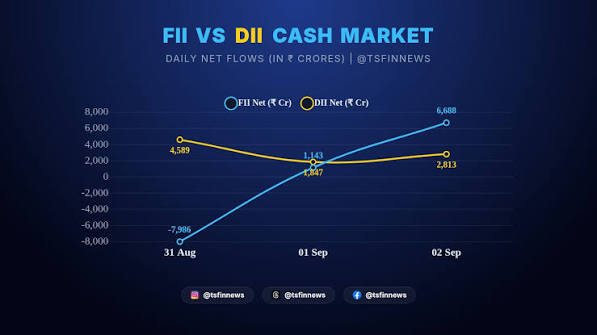

Foreign Institutional Investors (FIIs) and Domestic Institutional Investors (DIIs) are key players in the Indian equity market. They can affect the liquidity of the market, investor confidence, and short-term price fluctuations when they engage in buying and selling. Knowing how the FIIs and the DIIs are moving the market can then help investors make better sense of the daily movement and know the forces influencing the market.
What are FII and DII Flows?
Investments by foreign institutions in the Indian financial market are called Foreign Portfolio Investors (FIIs). They can be foreign mutual funds, pension funds, insurance companies, etc. investment institutions.
DIIs are organisations which are established in India and invest in the Indian markets. The major DII participants include mutual funds, insurance companies, banks and pension funds.
The data of FII and DII flow generally gives the value of the purchase and selling done by FII and DII in a trading session. Their net buying or selling activity is the difference between their purchases and their sales.
Why Do Institutional Flows Matter?
Institutional investors manage large pools of capital. As a result, substantial buying or selling by these participants can affect market liquidity and prices.
For example, strong FII buying may support demand for equities and contribute to positive market sentiment. Conversely, significant FII selling can increase supply and put pressure on prices, particularly when other investors also respond to the selling.
DII activity can sometimes offset FII movements. When foreign institutions sell heavily, domestic institutions may continue buying, helping provide liquidity and reducing the impact of foreign outflows.
FII Flows and Global Market Factors
FII activity is often influenced by developments beyond India. Changes in US interest rates, global economic growth, geopolitical events, commodity prices and currency movements can affect how international investors allocate capital.
When global investors expect better opportunities in developed markets or face higher borrowing costs, they may reduce exposure to emerging markets. On the other hand, improving global liquidity and stronger growth expectations can encourage greater investment in markets such as India.
Therefore, FII data should not be viewed independently. Investors can consider it alongside global market conditions and broader economic developments.
How DII flows influence market trends
DIIs have become an important source of domestic market liquidity. Mutual fund inflows, insurance investments and other institutional allocations can provide consistent demand for Indian equities.
DII buying may become particularly relevant during periods when foreign investors are reducing exposure. However, domestic institutions can also sell depending on valuations, fund flows and portfolio requirements.
The interaction between FII and DII activity can offer a broader picture than looking at either category alone. For instance, simultaneous buying by both groups may indicate strong institutional demand, while coordinated selling can increase downward pressure.
Reading institutional activity with price movements
FII and DII data becomes more useful when combined with price and volume information. Investors can observe whether institutional buying coincides with rising prices or whether selling is occurring during a broader market decline.
For example, heavy FII selling accompanied by falling index levels and high trading volumes may indicate increased selling pressure. However, a single day’s flow should not automatically be interpreted as a long-term market signal.
Institutional transactions can be driven by portfolio rebalancing, profit booking, hedging and other factors. Therefore, looking at several sessions or weeks can provide more meaningful context.
The Role of Institutional Flows in the Stock Market
Institutional activity can influence different segments of the stock market in varying ways. Large-cap companies may experience substantial institutional participation because they generally offer greater liquidity.
FII and DII preferences can also differ by sector. Foreign investors may increase or reduce exposure to information technology, financial services, pharmaceuticals or other sectors based on global and domestic conditions.
Investors should therefore examine whether institutional flows are concentrated in particular sectors or spread across the broader market.
Using FII and DII data for Trading Decisions
Institutional flow data is a good indicator that traders can use as one of their inputs to a short term market study. It may be used in conjunction with the price, trading volume, technical indicators, corporate news, and macroeconomic indicators.
But do not consider the FII or DII buying as an indicator to buy. Institutional investors can have different investment goals, time horizons and risk management approaches than individual traders.
Other key factors that should be taken into account for an investor are volatility and liquidity, since institutional activity may rapidly shift when new information is released.
Conclusion
The FII and DII flows give a glimpse into institutional involvement in the Indian equities. The data should be taken into consideration along with other indicators of the market, and their activity can affect the liquidity and sentiment of investors as well as the short-term movement of the price. Users of platforms like 5paisa can track 5paisa trading volume and incorporate other research into their investment strategy. Investors can use a disciplined approach to understand where the money is going and out of the market, rather than simply focusing on the day’s volume.