
Yoga Poses You Will Study During Teacher Training
When you sign up for a 200-hour yoga teacher training program in Bali, you are not just learning random poses. You are learning a system. Each pose connects to the next one. The way the curriculum is built matters. Someone spent time figuring out what order makes sense.
The poses you study depend on which program you choose, but certain ones show up in almost every Bali yoga teacher training course. These are the core poses. The ones every teacher needs to know. Understanding what you will study helps you get ready for training.
Most programs are organized by type: standing poses, seated poses, backbends, forward bends, twists, inversions, and arm balances. This organization is not random. Each group teaches something your body needs. When you train with the best yoga teacher training in Bali, you notice the order is thoughtful.
Standing poses first
Standing poses make up most of what you learn early in a Bali yoga teacher training for beginners program. These poses teach you grounding and stability. Your feet have to work. Your legs have to engage. Your pelvis stays put. Your spine does not collapse.
You work with mountain pose, warrior one, two, and three. Triangle pose, extended side angle, tree pose, and half moon. Each teaches something about balance, hip work, and leg strength. You explore them from different angles. You learn how to modify them for different bodies. You practice how to help someone else find the right alignment.
An intensive yoga teacher training spends weeks on standing poses. You learn what misalignment looks like. You practice how to guide someone into the correct position. You understand not just how to do the pose but how to teach it. That is where real teaching skills come from.
Seated poses teach hip work
Seated poses come next, and they are harder than they look. When you sit, you cannot use momentum. Your muscles have to do the work. This is where people actually feel hip opening.
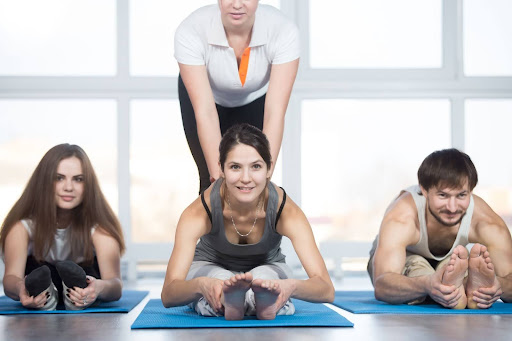
You work with the bound angle pose, pigeon pose, seated forward fold, cow face pose, and lotus pose. Different poses, different ways of opening the hips. The bound angle is direct. Pigeon goes deep into the glutes and hip flexors. Seated forward fold stretches hamstrings. The cow face opens multiple areas. Lotus is a strong hip external rotation.
A 300-hour yoga teacher training in Bali explores why different hips work differently. You learn that lotus does not work for everyone. That is not a problem. That is anatomy. Good teachers know this. They do not push students into shapes their bodies cannot make.
Backbends teach you to extend
Backbends teach your spine to extend backward. They also cause injury if alignment is wrong. So this section gets attention.
You work with the cobra pose, locust, bow pose, camel pose, and wheel pose. Each one builds on the last. Cobra teaches your back muscles to engage. Locust strengthens your whole backside. Bow combines hip and back work. The camel is deeper while the wheel is advanced.
Teachers at an affordable yoga teacher training in Bali teach these carefully. They show modifications. They emphasize safety. You learn that backbends are not about going deep. They are about using the right muscles and protecting your lower back.
Forward bends teach folding
Forward bends teach you how to fold from your hips safely. They calm your nervous system. They develop flexibility.
You encounter standing forward fold, seated forward fold, wide-legged forward fold, and head to knee pose. Each teaches hip flexion in slightly different ways. The key is hinging from the hips, not rounding your spine.
Twists teach rotation
Twists get studied because people do them wrong. They think twists mean forcing your spine to twist hard. Actually, you create length first, then rotate. During the best yoga teacher training program in Bali, you learn how this actually works physically.
You work with seated spinal twist, revolved triangle, reclined spinal twist, and twisted chair. Each teaches how your spine rotates when done correctly.
Inversions and arm balances
Later in your training, maybe in month three or four of a Bali yoga teacher training course, you encounter inversions and arm balances. These are harder. Your shoulders and wrists need strength. Your balance needs development.
You study headstand, shoulder stand, handstand, crow pose, and forearm stand. These are not just about doing the pose. They are about knowing when a student should not try them. How to build up to them safely. What comes first?
Why the order matters
What you study is not just a list to memorize. It is a system where each pose teaches something. By the end of your training, whether it is a 200-hour yoga teacher training in Bali or a longer program, you understand how poses connect. You know how to sequence them logically. You can teach them to different bodies.
The curriculum exists for a reason. Every pose has its place. The progression makes sense because it builds on itself. You do not skip around. You do not jump to hard things first. You move through them in order because that is how your body learns.
Yoga teacher training Bali programs in 2026 follow this same basic structure because it works. The body learns in a specific sequence. Alignment in basic poses enables advanced poses. Standing poses before arm balances. Simple before complex. That is not arbitrary. That is how humans actually learn movement.